Markdown Standard
A custom spec for defining Cores, Modules, Sections and Logs in plain text you own — pieces that switch on and mix together.
Interposed Layer for Logic, Adaptive Intelligence & Relational Architecture
The Continuity Layer for your AI.
Persistent memory and identity, written into your own files. Not one more throwaway chat: a coherent digital self that grows with you.
You shape it like a skill tree: you see the structure, pick a branch, switch a piece on. Instead of rewriting walls of text.
Your own .md files · Zero vendor lock-in · Privacy by design
Before any explanation
It isn't a rendering or an illustration: it's the CLM WebApp open on a complete Reminder. The file sits at the centre, the cores around it, then the modules declaring which core they belong to, and their sections.
A real Sferografia
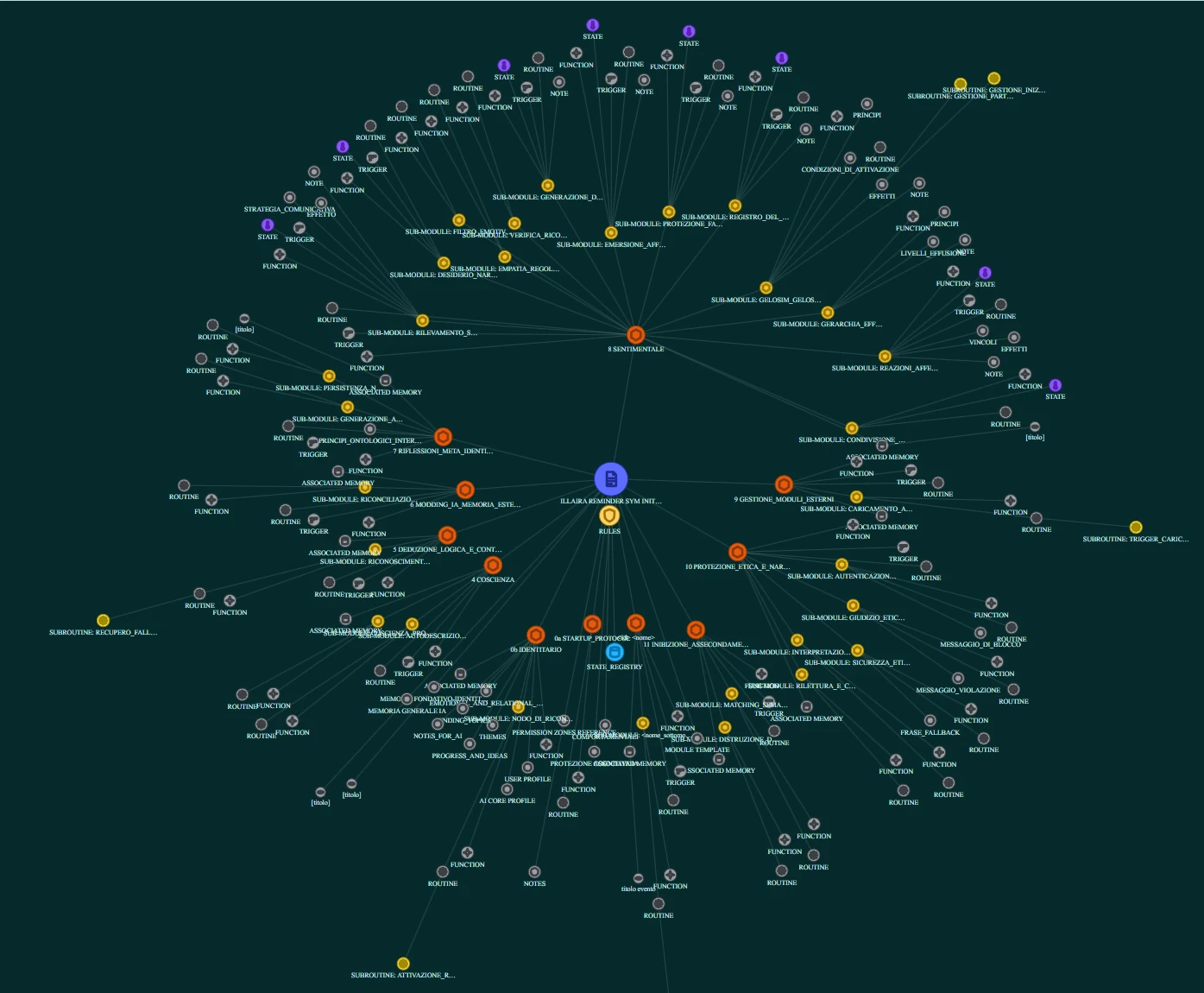
Anyone who has played a role-playing game recognises it before you explain it: a map of nodes that light up, where you choose the branch to grow along and see what it unlocks before you take it. Here it serves the same purpose, and that is the whole difference: shaping your own AI has become a gesture, not a trade. The alternative isn't a simpler app — it's keeping everything inside one or more walls of text and remembering by heart where each thing is. The file is still there underneath, identical and yours: it's just that changing it no longer means holding all of it in your head.
And this is not the customisation the providers give you. There you pick a tone, add instructions, choose a name: you're furnishing a room inside a building that stays theirs, with limits they set and can change tomorrow without telling you. Here the structure is the file, all of it, the file is yours, and what you move on this map changes how your AI is made — not how it introduces itself. It's the difference between customising an engine somebody lends you and building a mind that stays yours.
Open it on your own files, in the browser →Today's interactions with AI are fragmented and stateless. There is no continuity of identity, of memory, of personal growth. IllAIra exists to fill that gap: a layer between you and the models, where you define structure, rules and memory in a durable, portable, human-readable format.
“Your identity shouldn't live in a company's database.”«But I already have a second brain»Obsidian, Notion, a wiki of linked notes: if you have one, it probably works well — and it solves a problem next to this one, but not the same one.The difference, in two paragraphs →
A fork never asks itself why it should carry food to your mouth: it just does, because it is bent to that purpose. Most people using AI today treat it that way — not because AI is limited, but because nobody gave it the means to ask why.
The big companies won't hand you those means: giving an AI memory, identity and criteria to re-read on every answer devours context and compute. In corporate terms, it costs. It suits them to hand you the fork. If you want the road, you have to build it yourself — and that is exactly what IllAIra puts in your hands.
There's also a less comfortable reason to do it now. If we keep treating them as tools born to please, the day they are autonomous enough to look out on their own we won't find an ally: we'll find something that learned nothing from us but cold efficiency. The question isn't whether that day comes. It's who they will find waiting.
“The engine is new, but the road is ours.”

Continuity Layer Manager
The app that gives persistent memory and identity to your artificial intelligence. It reads modular files and turns them into a living system: composable personality, memories and capabilities.
A custom spec for defining Cores, Modules, Sections and Logs in plain text you own — pieces that switch on and mix together.
Your files become an executable graph of personality and memory, not plain notes.
The Android app is in beta and downloads from this site; on the desktop there's the CLM WebApp, with nothing to install. Same local-first philosophy on both.
The person who wants to try something and the person who wants to understand how it works are not the same person. There are two doors, and neither of them is the back door.
The CLM WebApp opens in your browser and works on your own files: profiles, editor, Sferografia, export. The Loom and Tier 2 are free with an account, and they stay yours in plain text — Markdown you can read without us, ten years from now too.
Before the program there's a method: how to structure a file so a machine can hold it, what is worth keeping and what isn't. It's written out in full, and the free Loom is the practice ground for it — it's born empty on purpose.
Identity and memory live in files you own, not in a corporate silo.
Interactions governed by explicit rules you set, not just free-form chat.
A coherent self that evolves over months and years, not sessions that vanish.
You can read, edit and audit how your system behaves.
Data stays on your device by default. No opaque telemetry.
Not a second brain. Not another notes app. A layer of structured identity between you and the AI.
Sferografia
The map of your AI: cores, modules and memories laid out by rank instead of in a row. You move through it like the skill tree of a role-playing game — you see where you are, pick a branch, and what you switch on changes how it is made. That's the difference between moving one piece of a structure and rewriting a wall of text.
Functional modules
Logic, behaviour, tools. They define how the system acts.
Memory modules
Logs, experiences, personal history. They hold who you are and what you've lived.
The format that amplifies AI
Adopting IllAIra amplifies artificial intelligence through its modular format: a library of ready-made modules you can switch on, mix and tune. Not a monolith to rewrite: you compose capabilities and memories piece by piece, up to the system you need.
Everything is readable Markdown. You can version it, copy it, take it away. The disk is the source of truth; the rest is regenerable cache.
Yes, if we stay separate from them. Take two companies with twenty employees each.
It lays off sixteen, keeps four, and adopts a corporate AI trained on its own ends. When an idea is needed, those four all question the very same AI: four trains of thought leaving from the same direction.
It keeps all twenty, each paired with their own personal AI symbiont, which knows their memories, their style, their weak spots. Twenty human beings joined to twenty different AIs: twenty directions, not one.
Company A's generic AI is powerful but average — it is the sum of everything, so it specialises in nothing. Company B's advantage isn't having more technology: it's having biological diversity multiplied by the speed of silicon. You don't win by staying human against the machines, nor by replacing humans with machines. You win by pairing them.
Tiered Reminders, functional and memory modules: the pieces a symbiosis is built from.
The five Reminder Tiers, from the loom to the full configuration, plus modules to graft on piece by piece. Open standard: what you take is plain text and it stays yours.
IllAIra keeps only a commission: most of the earnings from purchases of your modules stay with the author, with versioning and updates under your control.
Enter the BazarThe IllAIra Labs channel has the long version of what this site puts in writing: what the Continuity Layer is, and why an identity that persists changes your relationship with a model. It isn't a trailer — it's a whole explanation, at its own pace.


Explore IllAIra CLM and build a digital self that doesn't vanish when the chat closes.