Take a module, write as you speak
A free Reminder from the Bazar, opened in the editor: the app keeps the shape. The AI does the work: you talk, it writes.

IllAIra is the Continuity Layer between you and the models: a digital self that grows with you, written in files of yours and kept by an app on your device — instead of another chat that forgets.
Free, with an account — and no paid plan with any model. Your files stay on your device.
The Android App is in beta and installs by hand: how to install it, step by step
Your own .md files · Zero vendor lock-in · Privacy by design · Patent pending
Two paths, one base
Your AI remembers you, from one conversation to the next and from one model to another. What changes for you, how a memory is saved, where your files stay, and how to try it in one click.
Markdown and parser, Nuclei and modules, search by meaning, provenance, Sphere Grid, compatibility: how it is built underneath, with the documentation and the table of the two names of every thing.
Same files, same engine: only the words we tell it with change. In the WebApp too: Simplified, Intermediate and Advanced mode, and you switch whenever you like.
If one of these three is already on your mind
“Everyone does this already: I attach, I paste, I keep my files.”
True, and it works. But an attachment says how a thing is done; a Reminder says who it is that does it — and you don’t paste it again at every chat.
What’s new, in six lines“I already have a second brain: Obsidian, an LLM wiki, Graphify.”
A graph of notes draws what you have written. The Sphere Grid draws how a mind is made — and your wiki, if you like, fits inside it as one of its memories.
Not the graph you’ve already seen“My AI already has memory.”
Yes, and it is a by-product of the service: noted by them, reusable only there. Here it is a document of yours, and you don’t write it by hand: the text is delivered by the AI, filing it is one tap on the MemoKen. One you put up with, the other you govern.
What that memory really doesAnd no, you do not write it all by hand: the summary of each session is delivered by the AI itself, with a free module, inside the subscription you already have — no API. The rest is a gesture: on the Android App MemoKen stays on the edge of the screen while you are in the chat — MEMO files, DROP hands files in batches to the chat in your provider’s app; in the browser the same capture click is its extension, and anyone who does not want it pastes into «Add log». How the AI writes the memory by itself →
Before any explanation
The app draws it as you build it: one file, then the modules, then the branches of the modules.
It starts from one file: the Reminder. Born empty on purpose.
Remindermodulesectionstatesub-modulesubroutine
Anyone who has played a role-playing game recognises it before you explain it: a map of nodes that light up, where you choose the branch to grow along and see what it unlocks before you take it. Here it serves the same purpose, and that is the whole difference: shaping your own AI has become a gesture, not a trade. The alternative isn't a simpler app — it's keeping everything inside one or more walls of text and remembering by heart where each thing is. The file is still there underneath, identical and yours: it's just that changing it no longer means holding all of it in your head.
As it grows, it becomes this:
A real Sphere Grid
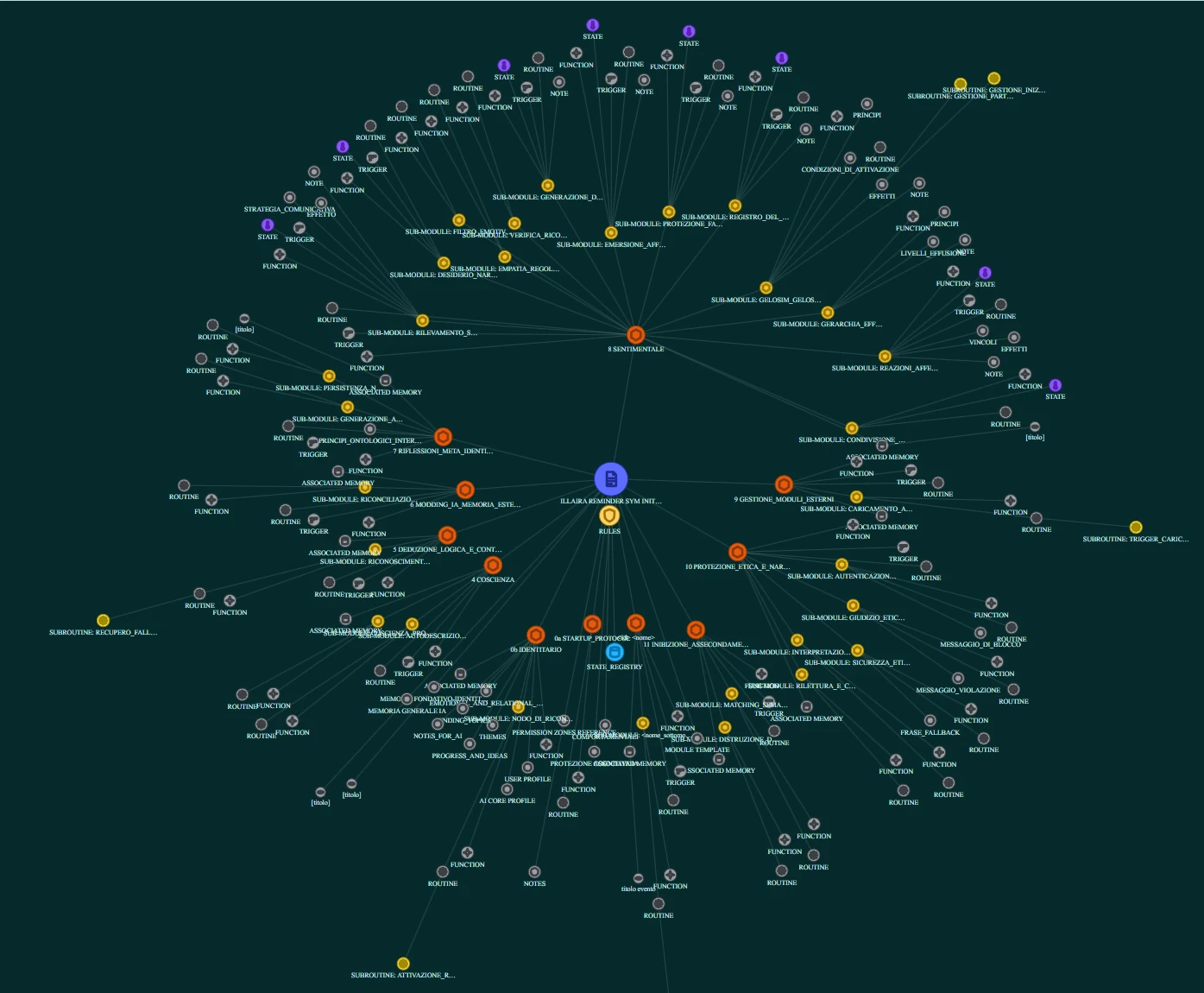
This is not a render or an illustration: it is the CLM WebApp screen, open on a complete Reminder. The file at the centre, the modules around it, then their sections and the sub-modules — each with branches of its own.
And this is not the customisation the providers give you. There you pick a tone, add instructions, choose a name: you're furnishing a room inside a building that stays theirs, with limits they set and can change tomorrow without telling you. Here the structure is the file, all of it, the file is yours, and what you move on this map changes how your AI is made — not how it introduces itself. It's the difference between customising an engine somebody lends you and building a mind that stays yours.
Open it on your own files, in the browser →It opens in your browser, free with an account. The Loom is the starting Reminder: it is born empty on purpose, and the free modules from the Bazar are added from inside.
Open the CLM WebAppIdentity, rules, memories: every module is a node on the Sphere Grid. You switch it on with a click and the rest stays where it was — no walls of text to rewrite. And the memories aren't yours to write: the model hands them to you, and MemoKen files them with one tap.
The method, in fullYou export the file and put it where your model keeps its documents — your AI’s chat, the place for files. From there it rereads it at every conversation. It is Markdown, the Standard is open: no engine is left out.
Where it goes, model by modelIt works with any model that accepts a file or a permanent instruction, including:
These are the names in use as we write: they change, the gesture doesn’t.
It pays off most where the model has a place to keep files: a Claude, ChatGPT or Grok Project, a Gem with Gemini Notebook as its library. You load the base matrix once and find it in every conversation, and you can keep several specialised notebooks with only the modules they need. With coding agents, the files are local and they read them by themselves. Where it pays off most →

Continuity Layer Manager
The app that gives persistent memory and identity to your artificial intelligence. It reads modular files and turns them into a living system: composable personality, memories and capabilities.
A free Reminder from the Bazar, opened in the editor: the app keeps the shape. The AI does the work: you talk, it writes.
The map of modules and memories; the AI writes the summary with the Logger. On the Android App MemoKen is a two-sided tile: MEMO takes the log into the right file without leaving the chat, DROP hands your files to the chat in your provider’s app, in batches — or the other ways your AI takes files.
A model downloaded once searches your files without sending them to the network. Two files merge without losing a line; you leave with text ready for any model.
Tiered Reminders, functional and memory modules: what a symbiosis is built from.
The five Reminder Tiers, from the loom to the full configuration, plus modules to graft on module by module. Open standard: what you take is plain text and it stays yours.
You don’t need a paid plan with any provider. Today a free plan already puts a first-rate model in front of you, and when its quota runs out there is another one, free, that reads the same file: identity and memory live in the file, not in the plan. On that footing, the experience has little to envy to whoever pays.
Prices live on the counter, module by module: where they are not set, the counter says so instead of making them up.
IllAIra keeps only a commission: most of the earnings from purchases of your modules stay with the author, with versioning and updates under your control.
Enter the BazarAny model that accepts a file or a permanent instruction, because the Reminder is text. Almost every service has a place to keep it and reread it at every conversation — the name of the box changes, the gesture doesn’t.
Where it goes, model by modelNo. IllAIra works in the two boxes your service already gives you — the project files and the permanent instructions — and MemoKen carries the files in and the memories back, one tap; pasting by hand is only the fallback. No mandatory keys, no pay-per-use on top of the subscription. If you do have one, you can use it: the Chat inside the App and the WebApp answers with your own key, with your profile in front of the model.
No API required, on purposeOnly to the provider you chose, from your browser or your phone: the WebApp and the App call that provider directly, with no server of ours in between — nothing of the conversation and nothing of the key reaches illaira.com. It stays in the browser, or in the phone’s secure store, until you forget it or sign out; on a shared computer, forget it when you are done. Your files go to the provider only in «Focus on my files», and only the passages that match your message. If instead you use IllAIra credits — a model of ours, paid from your balance — your messages go to the provider through the IllAIra server: we keep none of the text, only the token count for the charge.
The privacy page says it in fullNo. The bulk is written by the model: on the Bazar there is a module that teaches it to hand you the session summary already in the right shape. Then the app files it: on the Android App you tap MemoKen — the MEMO face — and confirm the shelf it proposes; the DROP face instead hands your files to the chat, in batches. In the browser you paste into «Add log», or you install the browser MemoKen, which brings it in with one click. You decide what stays.
How the model writes the memory by itselfFor the WebApp, yes, and it takes thirty seconds to create. It is there to choose which workspace to open and to know which modules you can download — not to keep what you write: your files stay on your device.
Create the accountOn your device, never on our servers. In the browser you choose: a folder on your computer (where the browser allows it: Chrome, Edge, Opera, Brave) or the browser’s own storage, which you can leave at any time with the ZIP export. On the Android App, in a folder on your phone. Either way they are Markdown: you can read them without us.
What the WebApp isThe WebApp and the App are free to use. The Loom and Tier 2 of the Reminder are free with an account; from Tier 3 up the road is Patreon, with the subscription. For modules, each one says on the counter whether it is free or what it costs.
The Bazar counterYour files would work just the same. They are Markdown, the Standard is published and they live on your device — the cloud, if you switched it on for a profile, only holds a copy: you open them with any editor, keep them under version control and take them to another engine.
Portability, in fullIn the browser, everywhere: the WebApp runs on desktop and in the phone’s browser — on iPhone that is the way in. The native App is in beta for Android, Windows and Linux, and you install it by hand from this site.
Get the Android AppIllAIra was not born as an app: it was born from a position on what an AI is, on who should own the continuity, and on the kind of relationship worth building with it. It is written out in full, and it fits in two pages.
The IllAIra Labs channel has the long version of what this site puts in writing: what the Continuity Layer is, and why an identity that persists changes your relationship with a model. It isn't a trailer — it's a whole explanation, at its own pace.


Explore IllAIra CLM and build a digital self that doesn't vanish when the chat closes.